a.muse.ing. architecture.
So recently, my X feed has been blasting off with Meta's new product release, Muse, which is a personalized AI agent that works 24/7 to make your dreams come true (not sure, but this is what they said in the tweets and all). This product gained a lot of attention due to one more factor: Alexandr Wang. This person has made this company gain quite some attention within a week. He has been assigned as the Chief AI Officer at Meta, and now he's using all of his powers to make this product a blast-off on the internet. For people who don't know who Alexandr Wang is, he's the founder of ScaleAI, which he founded when he was just 19 years old. ScaleAI helps other orgs with AI datasets and training. Now, by being the Chief AI Officer of Meta, he's able to bring the powers of ScaleAI to Meta and make this product a great one.

So being a software engineer myself, I did some research on the product—what it is, how it works, and its architecture—and let me tell you, it's an ART for sure! First off, Muse is a personalized AI assistant which can buy products, call people on your behalf, book tickets and restaurants, and do a lot of things by working 24 hours just so that you can make more use of your precious time and all your wants and needs will be covered asynchronously. You can be working, jogging, prepping your lunch, or just watching a movie, and Muse would be working for you and making sure your deals are done right. You can literally ask it to buy a concert ticket when it goes live, pay the price, and save it on your phone without your own intervention. Isn't it something different from what these generic AI companies are making these days?
From an engineer's perspective, the architecture is even more amazing. When a new user creates their account, it creates a VM instance on cloud servers, and the VM is secured and accessible for that particular account only. The VM stores all the user's credentials (like passwords for accounts, etc.) in a secured, encrypted vault. Every VM has a shared browser, internet, etc., which the AI agent can use to browse through e-commerce platforms, booking sites, etc., and then use for booking/buying activities. But now the question that can be raised is: if sensitive credentials are stored in the VM and then used in the browser itself, isn't that a security breach or privacy issue? No. After storing the sensitive creds, whenever the agent wants to perform any action outside of the VM instance into a shared activity, the VM instance issues a token which can be used to perform that shared activity task, which has two positive sides: 1) the user's own creds didn't have to be used, and 2) that particular token is useless outside that activity. So this is one of the architectural propositions which I liked the most.
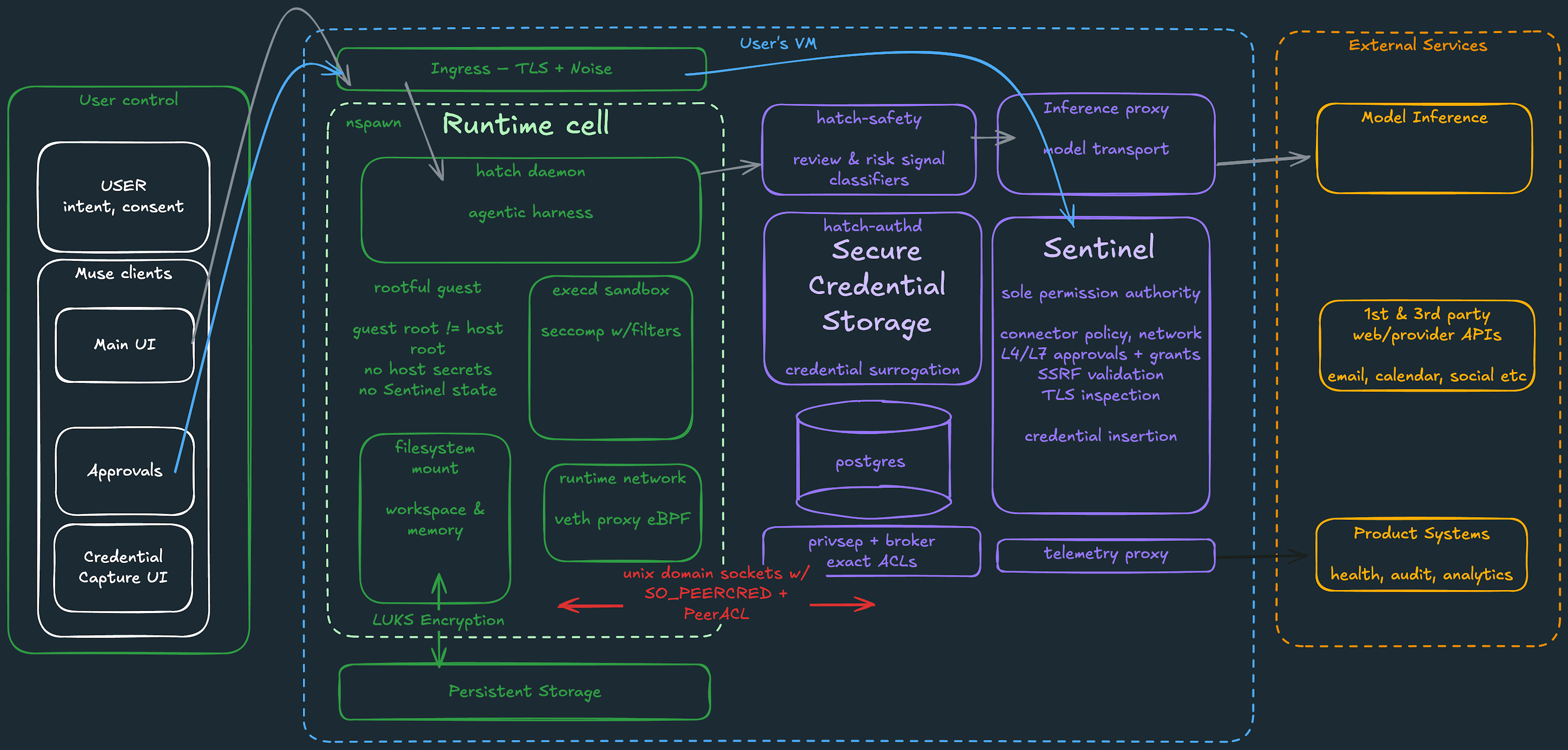
Also, for egress actions (outgoing network requests to websites, etc.), the VM cannot perform them on its own; instead, it communicates with a service called Sentinel which has to accept its policies, and only after that can it perform all the egress actions. Sentinel is basically Muse's security guard. It sits between the AI and the outside internet. Whenever Muse wants to open a website, call an API, send data, or use a connected service, Sentinel checks whether that action is allowed and safe. This makes all of the outgoing activities secure.
After a long time, a product has launched that has caught my attention and made me read about its workings and architecture. I still feel like, in this era of AI Slop, some brilliant minds are still making breakthrough architectural changes and making products that will make our lives easier.
In an era dominated by superficial AI wrappers, Meta's Muse architecture shows what happens when real systems engineering takes center stage. Sandboxed environments, ephemeral tokens, and explicit security boundaries—this is what robust AI deployment actually looks like.
I'm definitely going to keep analyzing this system and build a few proof-of-concept projects inspired by this model.